Lord Of Petals...
Posted: Wed Jul 15, 2026 5:56 pm
Character Details
Name: Kalm Mizu. Though he is typically referred to as "Erabarashi" by members of his clan.Order: Human
Age: 24
Apperance
Typical Attire: Kalm's wardrobe is utilitarian to the point of austerity. While other members of his clan are draped in expensive garments and silks, he favors dark fabrics — deep blues, charcoal grays, and blacks — that allow him to move unseen during night operations. His clan robe, worn only during formal ceremonies, is an elaborate affair of silver-threaded silk emblazoned with the Mizu Tsuki crest (a crescent moon cradled in cherry blossoms), but he despises wearing it, calling it "a costume for a puppet."His practical attire consists of a fitted haori jacket with hidden pockets for talismans and blades, loose hakama pants for unrestricted movement, and tabi boots with reinforced soles. He always wears a thin silver chain around his neck bearing a small pendant of the Moon Goddess — the only personal ornament he permits himself.
Unique Marks
Due to the Meiryo-sa, Kalm's irises feature a striking, pale-blue luminescence that constantly shimmers like moonlight on water.
Frost-Burn Scars: Intricate, branching scars that resemble crystallized ice trace up his forearms—the physical toll of repeatedly handling the volatile, supercooled Suigetsu orbs.
Distinguishing Mannerisms: Kalm stands with perfect posture, shoulders squared, spine straight — the posture of someone who has been corrected every time he slouched since childhood. When seated, he perches on the edge of chairs rather than slumping into them. He moves with deliberate, economical precision, never making an unnecessary gesture. His hands are often clasped behind his back or resting on the hilt of his fans.
Personality
Kalm's sense of responsibility is not merely strong — it is the bedrock upon which his entire personality is constructed. Having been raised with the constant reminder that he is the clan's primary defense against extinction, he has internalized the belief that his personal needs are subordinate to collective survival. This manifests as a relentless self-discipline and an almost punishing work ethic. He trains until his body fails, studies until his eyes burn, and pushes himself far beyond reasonable limits — not because he seeks excellence, but because he believes mediocrity would be a betrayal of everyone who depends on him.
This trait makes him dependable to the point of being taken for granted. The clan expects his sacrifice as a matter of course, and Kalm has come to expect nothing more. The persona Kalm presents to the world is one of frozen detachment. He speaks sparingly, rarely smiles, and maintains a posture of regal disinterest that drives away all but the most determined interlocutors. This emotional armor serves multiple purposes: it filters out the sycophants and political operators who would otherwise clutter his life, it protects him from the vulnerability he cannot afford as a weapon, and it conserves the emotional energy he expends in his singular focus on demon-hunting.
Yet beneath this ice lies a wellspring of passion that has not been extinguished — merely redirected. Kalm's devotion to Tsukuyomi is genuine and fervent, bordering on religious ecstasy. His love for his brother Marius is fierce and protective to the point of smothering. His hatred of demons is not cold calculation but a white-hot rage that occasionally cracks through his composure in flashes of terrifying intensity. He is not apathetic; he is a pressure cooker with the valve sealed shut.
Kalm's dojutsu, Meiryo-sa, grants him the ability to perceive the truth behind falsehood — not through magic, but through an almost supernatural insight into human motivation. He can sense the self-interest beneath the fawning praise of clan elders, the jealousy masked as concern by his father's other subordinates, the fear disguised as respect. This constant exposure to the gap between presentation and reality has left him deeply cynical about human sincerity.
He does not believe that people are inherently evil, but he has lost faith in the possibility of genuine connection. Every smile he sees carries an agenda. Every kind word is weighed for hidden currency. This loneliness is perhaps the deepest wound Kalm carries — far deeper than the death of Juri, because it colors every relationship he might otherwise have.
Kalm's moral framework is absolute and uncompromising. Because his purpose was defined for him before he could form his own identity, he has latched onto that purpose with religious fervor. The shamanic abilities of the Mizu Tsuki were granted as a sacred covenant with Tsukuyomi — a divine mandate to protect humanity from the demon threat. To see those abilities commercialized, bartered to wealthy patrons for profit, strikes him as not merely distasteful but blasphemous.
This rigidity makes him a poor diplomat and an even worse politician. He cannot compromise on principles he considers sacred, and he has no patience for the gray-area thinking that leadership requires. His refusal to bend on these issues has made him a persistent headache for his father and a target for those who would see him removed from the succession.
Tribe
Mizu Tsuki
Show
Excerpt from Chronicles of Vescrutia: A Treatise on the Shamanic Tribes and the Edo Epoch
Compiled by High Archivist Valerius
The Mizu Tsuki: Masters of the Frozen Moon
To understand the geopolitical and spiritual landscape of antiquity, one must examine the metallurgical and metaphysical evolution of the Mizu Tsuki—the Water Moon clan. Indigenous to a territory perpetually veiled in dense, localized mist, the Mizu Tsuki represent a fascinating divergence from traditional shinobi sects. Rather than generating and expelling water from their own physiological reserves, the clan's Anthem (their genetic bloodline trait) allows them to subjugate ambient environmental moisture. By weaponizing barometric pressure, kinetic temperature fluctuations, and harnessing lunar naten, they achieve meteorological dominance over their adversaries.
However, the true catalyst for the clan’s martial and religious transformation was the cataclysmic event known to historians as the Demon Siege of Edo.
The Breach and the Crimson Pact
Centuries ago, an interdimensional fissure dubbed "The Breach" ruptured the fabric of Vescrutia, disgorging a malevolent species recorded in the annals as the Acheri, or Demons. The ensuing conflict revealed a fatal inadequacy in conventional warfare; standard forged steel and traditional ninjutsu proved utterly impotent against the Acheri's dark naten and rapid cellular regeneration. Archival texts indicate that in the earliest, bloodiest days of this invasion, the Mizu Tsuki were nearly driven to extinction. Their elemental Anthem, though versatile, lacked the spiritual lethality required to permanently sever a demon's life force.
The paradigm shift occurred during the clan's darkest hour. According to legend, the besieged Mizu Tsuki leader, battered and bleeding against the village's sole surviving cherry blossom tree, invoked the dormant deities of Edo in a final, desperate plea for salvation. The entity that answered this supplication was Tsukuyomi, the Lord of Petals. Identified in early Shamanic texts as an Elder One and a foundational pillar of the heavenly pantheon, Tsukuyomi had been slumbering within the ancient flora. In exchange for the preservation of his people, the clan leader entered into a divine covenant with the Elder Spirit. He was consecrated as the Erabarshi—"The Chosen"—and fashioned into the mortal instrument of the Moon's Will.
The Esoteric Arts and Cultural Shift
This divine suffusion of Tsukuyomi’s power birthed two esoteric disciplines that would permanently alter the trajectory of the Mizu Tsuki:
The Meiryo-sa: A specialized dojutsu (ocular technique) that permanently altered the user's vision, granting them the ability to pierce through falsehoods. This served as an essential evolutionary countermeasure, allowing the clan to dispel the illusions and glamour that the Acheri utilized to seamlessly disguise themselves as humans.
The Gekkosui: While the Meiryo-sa provided the Mizu Tsuki with the necessary sight to identify their disguised demonic adversaries, it was the Gekkosui that provided the lethal means to eradicate them. Early martial historians often misunderstood the Gekkosui as merely a variation of standard water-release techniques. In truth, it is a highly caustic and lethal application of lunar naten. The Gekkosui functions as a holy poison specifically tuned against the Acheri. When infused into the clan's hydro-kinetic attacks, it permanently halts demonic cellular regeneration. Archival battlefield reports describe a fascinating metaphysical reaction: when a demon is frozen by the Gekkosui, their dark naten is entirely neutralized. Rather than thawing or breaking into standard ice, the demon's form shatters into harmless, glowing ash, irrevocably severing their tether to the mortal plane.
Ultimately, the desperate pact forged beneath the dying cherry blossom tree birthed more than mere survival tactics; it sparked a 5,000-year cultural metamorphosis. The Mizu Tsuki transitioned from a geographically isolated shinobi clan into a devout society of demon hunters, their society now inextricably bound by worship, reverence, and the eternal vigil of the Lord of Petals.
Compiled by High Archivist Valerius
The Mizu Tsuki: Masters of the Frozen Moon
To understand the geopolitical and spiritual landscape of antiquity, one must examine the metallurgical and metaphysical evolution of the Mizu Tsuki—the Water Moon clan. Indigenous to a territory perpetually veiled in dense, localized mist, the Mizu Tsuki represent a fascinating divergence from traditional shinobi sects. Rather than generating and expelling water from their own physiological reserves, the clan's Anthem (their genetic bloodline trait) allows them to subjugate ambient environmental moisture. By weaponizing barometric pressure, kinetic temperature fluctuations, and harnessing lunar naten, they achieve meteorological dominance over their adversaries.
However, the true catalyst for the clan’s martial and religious transformation was the cataclysmic event known to historians as the Demon Siege of Edo.
The Breach and the Crimson Pact
Centuries ago, an interdimensional fissure dubbed "The Breach" ruptured the fabric of Vescrutia, disgorging a malevolent species recorded in the annals as the Acheri, or Demons. The ensuing conflict revealed a fatal inadequacy in conventional warfare; standard forged steel and traditional ninjutsu proved utterly impotent against the Acheri's dark naten and rapid cellular regeneration. Archival texts indicate that in the earliest, bloodiest days of this invasion, the Mizu Tsuki were nearly driven to extinction. Their elemental Anthem, though versatile, lacked the spiritual lethality required to permanently sever a demon's life force.
The paradigm shift occurred during the clan's darkest hour. According to legend, the besieged Mizu Tsuki leader, battered and bleeding against the village's sole surviving cherry blossom tree, invoked the dormant deities of Edo in a final, desperate plea for salvation. The entity that answered this supplication was Tsukuyomi, the Lord of Petals. Identified in early Shamanic texts as an Elder One and a foundational pillar of the heavenly pantheon, Tsukuyomi had been slumbering within the ancient flora. In exchange for the preservation of his people, the clan leader entered into a divine covenant with the Elder Spirit. He was consecrated as the Erabarshi—"The Chosen"—and fashioned into the mortal instrument of the Moon's Will.
The Esoteric Arts and Cultural Shift
This divine suffusion of Tsukuyomi’s power birthed two esoteric disciplines that would permanently alter the trajectory of the Mizu Tsuki:
The Meiryo-sa: A specialized dojutsu (ocular technique) that permanently altered the user's vision, granting them the ability to pierce through falsehoods. This served as an essential evolutionary countermeasure, allowing the clan to dispel the illusions and glamour that the Acheri utilized to seamlessly disguise themselves as humans.
The Gekkosui: While the Meiryo-sa provided the Mizu Tsuki with the necessary sight to identify their disguised demonic adversaries, it was the Gekkosui that provided the lethal means to eradicate them. Early martial historians often misunderstood the Gekkosui as merely a variation of standard water-release techniques. In truth, it is a highly caustic and lethal application of lunar naten. The Gekkosui functions as a holy poison specifically tuned against the Acheri. When infused into the clan's hydro-kinetic attacks, it permanently halts demonic cellular regeneration. Archival battlefield reports describe a fascinating metaphysical reaction: when a demon is frozen by the Gekkosui, their dark naten is entirely neutralized. Rather than thawing or breaking into standard ice, the demon's form shatters into harmless, glowing ash, irrevocably severing their tether to the mortal plane.
Ultimately, the desperate pact forged beneath the dying cherry blossom tree birthed more than mere survival tactics; it sparked a 5,000-year cultural metamorphosis. The Mizu Tsuki transitioned from a geographically isolated shinobi clan into a devout society of demon hunters, their society now inextricably bound by worship, reverence, and the eternal vigil of the Lord of Petals.
A Treatise on the Hidden Zenith: Fushimashi Village Betwixt the Cherry Blossoms
Show
*Excerpt from the Sir Rian Mizu-Tsuki, Lunar Archivist*
To the uninitiated cartographer, the eastern highlands present nothing but a hostile expanse of impassable geography. Yet, nested within this treacherous topography lies the ancestral seat of the Mizu clan—Fushimashi. Though colloquially referred to as a "village" by its inhabitants, this humble designation is a masterclass in understatement. Fushimashi is an architectural and spiritual marvel, a thriving pseudo-metropolis shielded from the ravages of the outside world by a seamless blend of divine intervention, formidable natural geography, and peerless abjuration magic.
---
Fushimashi was not settled; it was strategically enshrined. The settlement is cradled within a violent collision of tectonic and fluvial forces. A formidable perimeter of jagged, cloud-piercing mountain ranges surrounds the territory on all sides, their sheer cliff faces rendering traditional traversal impossible.
Weaving through these mountains is a complex network of white-water rivers and abyssal canyons. These natural trenches act as moats of staggering scale, funneling away any stray wanderers and providing an absolute geographical lockdown. To attempt to breach Fushimashi by foot is to wage war against the very bones of the earth.
Perhaps the most striking anomaly of Fushimashi is its localized biome. Through the enduring spiritual influence of Tsukuyomi, the Lord of Petals, the region's indigenous flora has undergone a radical, divine evolution. The mountainsides and inner valleys are carpeted by an endless, impossibly dense forest of cherry blossom trees that remain in a state of perpetual, vibrant bloom, regardless of the season.
This sea of pale pink and white is more than an aesthetic wonder; it is a manifestation of raw holy energy. The falling petals carry the ambient thermal kinetic resonance of the Mizu clan's arts.
At the geographical and spiritual epicenter of the metropolis stands the Grand Cherry Blossom, Selene. This colossal, ancient tree dwarfs the surrounding architecture, its roots webbing deeply into the bedrock and its canopy spreading like a crystalline canopy over the inner sanctum. It serves as a sacred nexus, a living monument to Tsukuyomi where the clan's most critical rites—including the fateful emergence of the Erabarashi—are conducted.
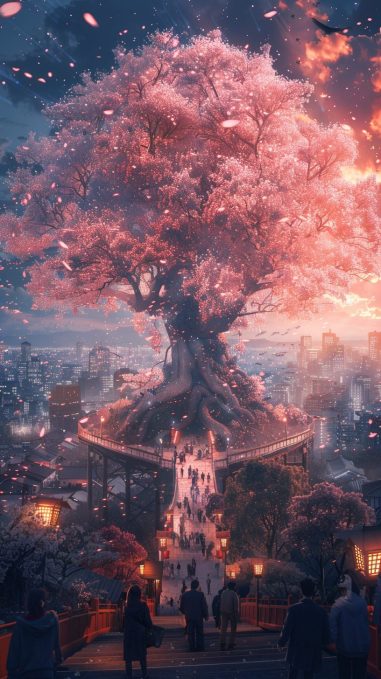
Despite its traditional nomenclature, Fushimashi boasts the infrastructure, density, and verticality of a small metropolis. The Mizu clan has masterfully integrated high-concept architectural engineering with ancient aesthetic principles. Because the canyon walls restrict outward expansion, the city is built upwards and downwards. Towering pagodas and multi-tiered estates seamlessly interlock with the cliff faces, suspended over the roaring rivers by gravity-defying bridges of tension-forged steel and enchanted stone.
There is no jarring industrialization here. The towering structures utilize polished dark woods, slate roofing, and luminous, pale-blue lanterns that mimic the glow of the moon. It is a "city" of a few hundred thousand, operating with the hushed, disciplined efficiency of a monastery. The natural rivers have been harnessed into a sprawling, immaculate aqueduct system that powers the city's forges, regulates the temperature of the subterranean training grounds, and feeds the localized hydroponic gardens.
The Mona Veil of the High Priestess
Even with its imposing natural barriers, a metropolis of this magnitude would inevitably draw the gaze of Vescrutia's darker denizens. Fushimashi's ultimate defense is absolute obfuscation.
The entire region is encapsulated within an immense, invisible warding sphere maintained by the reigning High Priestess. This barrier bends both light and spatial reality, rendering the city completely undetectable to mundane senses and arcane scrying alike. To an outsider flying overhead or standing at the edge of the perimeter canyon, there is nothing but untouched wilderness and mist.
This ward is strictly necessary due to the relentless existential threats bordering their lands:
The Acheri: The demonic entities that relentlessly seek to corrupt and consume the continent. The barrier acts as a holy filter, repelling their dark *naten* and preventing organized incursions.
The Zoku (The Demon Clan): A savage, neighboring barbarian tribe that long ago forsook their humanity to pledge allegiance to the Acheri. Serving as the demons' mortal vanguard, the Zoku constantly patrol the outer mountain ranges, hunting for cracks in the High Priestess's veil. They are a brutal, corrupted people, their bodies twisted by the demonic pacts they have forged, and they remain the most persistent immediate threat to Fushimashi's absolute secrecy.
In summation, Fushimashi is not merely a settlement; it is a meticulously engineered, divinely blessed bastion. It stands as a testament to the Mizu clan's unwavering discipline—a radiant, hidden jewel defying the darkness that seeks to consume it.
Family
Show
Marius Mizu Tsuki — Younger Brother. The most important person in Kalm's life. Marius, age 19, is everything Kalm is not — warm, sociable, genuinely kind in a way that does not carry hidden agendas. Where Kalm sees through everyone's deception, Marius seems to bring out their better natures. He is the last remaining connection to the boy Kalm used to be, and Kalm would die — would kill, would burn the world — to protect him.
Their relationship is complicated by Kalm's protective intensity. He struggles to allow Marius any independence, constantly monitoring his safety to the point of smothering. Marius, in turn, loves his brother fiercely but is frustrated by Kalm's inability to trust him to handle himself. This tension is a source of quiet pain for both of them.
Toshiro Mizu Tsuki — Father / Clan Head: The current leader of the Mizu Tsuki and head of the Yakei Company. Toshiro is a pragmatic man who loves his son but cannot understand him. He sees Kalm's rigidity as naive, his refusal to engage with the clan's commercial interests as a failure of imagination, and his obsession with demon-hunting as a waste of potential. Their relationship is defined by mutual respect without mutual understanding — Toshiro respects Kalm's power and dedication, but cannot comprehend his son's ideological opposition to the family's evolution.
Their ideological conflict is the central fracture in their relationship. Toshiro believes the Yakei Company is necessary for the clan's survival in a changing world; Kalm believes it is a betrayal of everything their ancestors fought for. Neither will yield, and both know that their inability to reconcile may ultimately tear the clan apart.
Yui Mizu Tsuki — Mother A gentle woman who has spent two decades watching her eldest son become something more than human. She loves Kalm unconditionally but has long since lost the ability to reach him on an emotional level. She is the one person before whom Kalm's coldness occasionally falters — not because she is exempt from his cynicism, but because her love is so undemanding that it cannot be mistaken for sycophancy.
Their relationship is complicated by Kalm's protective intensity. He struggles to allow Marius any independence, constantly monitoring his safety to the point of smothering. Marius, in turn, loves his brother fiercely but is frustrated by Kalm's inability to trust him to handle himself. This tension is a source of quiet pain for both of them.
Toshiro Mizu Tsuki — Father / Clan Head: The current leader of the Mizu Tsuki and head of the Yakei Company. Toshiro is a pragmatic man who loves his son but cannot understand him. He sees Kalm's rigidity as naive, his refusal to engage with the clan's commercial interests as a failure of imagination, and his obsession with demon-hunting as a waste of potential. Their relationship is defined by mutual respect without mutual understanding — Toshiro respects Kalm's power and dedication, but cannot comprehend his son's ideological opposition to the family's evolution.
Their ideological conflict is the central fracture in their relationship. Toshiro believes the Yakei Company is necessary for the clan's survival in a changing world; Kalm believes it is a betrayal of everything their ancestors fought for. Neither will yield, and both know that their inability to reconcile may ultimately tear the clan apart.
Yui Mizu Tsuki — Mother A gentle woman who has spent two decades watching her eldest son become something more than human. She loves Kalm unconditionally but has long since lost the ability to reach him on an emotional level. She is the one person before whom Kalm's coldness occasionally falters — not because she is exempt from his cynicism, but because her love is so undemanding that it cannot be mistaken for sycophancy.
Anthem
Name: KakuClass: Bea
Description: Kalm’s Anthem allows him to command ambient environmental moisture. By weaponizing barometric pressure and harnessing motisure, Kalm achieves meteorological dominance over his surroundings, turning the very atmosphere into a freezing weapon.
Traits:
Name: Meiryo-saClass: Dea
Description: Dojutsu that represents Tsukuyomi's greatest spiritual gift. Meiryo-sa operates on a perceptual level that borders on the metaphysical.
Passive Effects:
Truth Perception: Kalm can see through any form of deception — not through supernatural magic, but through an instinctive reading of micro-expressions, body language, and the subtle tells that reveal hidden intention. This works equally well on humans, who attempt to mask their emotions, and on demons, whose monstrous natures are revealed beneath their glamour.
Spiritual Vision: He can perceive spiritual energy in its various forms — the lingering emotions attached to objects, the auras that surround living beings, and the distinct signatures of demonic presence. To him, the world is layered with invisible truths that ordinary people cannot see.
Enhanced Reflexes: The dojutsu enhances his reaction time to superhuman levels, allowing him to dodge attacks that would be impossible for normal perception.
Thermal Kinetic Discipline: Through rigorous training, Kalm possesses an innate, passive understanding of thermal physics. This allows him to manipulate the kinetic energy of moisture on contact, instantly dropping its temperature to a supercooled state without the need for traditional casting forms.
Lunar Kinesis. Kalm's blessing allows him to manipulate lunar light to control other objects as well. With this, he can telepathically manipulate objects or things that he marks with his Lunar naten. His primary use of this is the fans he uses to fight with.
Lunar Conversion. In times when the moonlight is thin or obsolete, Kalm, being connected to an Elder Moon spirit, possesses the ability to convert his naten into lunar energy. Such a feat is typically a last resort as the process is draining.
Emotional Control: In high-stress situations, Kalm remains terrifyingly calm, able to think and act with perfect clarity even when those around him are panicking.
Physical Courage: He has no fear of death or pain. Having been conditioned from childhood to endure suffering, he can push through injuries that would cripple ordinary fighters.
Faction: Stellar Warlords. They are part of the Shaman lineage of the Warlords. However, they do not concern themselves much with the political prospects of Edo's endless civil war and only care about eradicating the Acheri and turning a profit from their endeavors. For them, it matters little who the Stellar Supreme is, as they have a duty geared towards saving Edo from a foe that often goes unseen.
Arbiters:
Gekkosui:Class: Ava
Description: Kalm channels lunar light to create a highly caustic, holy poison tuned specifically against the Acheri. When infused into his hydro-kinetic attacks, it permanently halts demonic cellular regeneration. When a demon is frozen by the Gekkosui, their dark naten is neutralized, and they shatter into harmless, glowing ash. This effectively kills an Acheri both physically and spiritually.
Suigetsu (Water Moon):
Class: Ava can be enhanced via bea
Description: The Mizu's signature art, of which Kalm is a prodigy. He forges hyper-compressed, spherical constructs of atmospheric moisture, suspending them in a highly volatile, "supercooled" liquid state. Glowing with a pale blue luminescence, these orbs look like miniature, cratered moons. Upon impact, they burn silver, and the kinetic energy triggers an instantaneous phase change, flash-freezing the target or causing a multi-meter "frost-bloom" across the terrain. Kalm's proficiency with the clan technique is otherworldly. He has such a fine-tuned grip of the Suigestu technique that he has created several different forms of this arbiter, creating a style of combat that only he possesses the skill to utilize.
Senpū (Flash)
Class: Ava
Description: The user creates 3–5 small, fast-moving Suigetsu orbs that act as homing projectiles. Elite members will lace these with Gekkōsui to pierce and rot demonic flesh.
Rin(Ring)
Class: Cea
A defensive application where several moons rotate rapidly around the user. Any incoming physical attacks, weapons, or fire-based jutsu are instantly neutralized and flash-frozen upon touching the orbit.
Sealed Phases
Show
The Suigestu is a very powerful technique that means nigh certain death for not only its victims but the caster as well. That said, there are techniques within the Mizu clan that are strictly forbidden for anyone to use as they pose too great a danger to friend and foe alike. They are known as the Sealed Phases.
Sealed Phased: Keiki Mestu(Total Ruin)
The ultimate clan technique. The user condenses all atmospheric moisture in a wide radius to form one massive, singular Suigetsu orb. When dropped, it creates an absolute-zero shockwave that flash-freezes an entire battlefield.
Here is a technique tailored to Kalm's existing lore, perfectly blending his connection to Tsukuyomi (the Lord of Petals) with his mastery over the supercooled *Suigetsu* arts. You can copy and paste this directly into your Arbiters section:
Sealed Phase: Suigetsu: Ōka (Water Moon: Cherry Blossom)
Class: Ava
Description: A beautiful but devastating application of Kalm’s thermal kinetic discipline and Lunar Kinesis, serving as an homage to the Lord of Petals. Kalm forms a standard Suigetsu orb but intentionally destabilizes its internal barometric pressure. With a precise motion of his hand or fan, he commands the orb to shatter, fracturing it into hundreds of razor-thin, supercooled moisture shards shaped perfectly like falling cherry blossom petals.
Borne on the ambient air currents manipulated by his *Kaku* Anthem, this localized, glowing blue "blizzard" violently swarms the target. Each petal acts as a small, hyper-sharp blade that maintains its volatile, supercooled state until the moment it breaks the skin. When a petal slices through a target, the kinetic friction of the cut triggers an instantaneous phase change. Instead of simply bleeding, the microscopic lacerations instantly flash-freeze, locking the target's joints and spreading debilitating frostbite directly into their muscle tissue and bloodstream.
When Kalm laces the Ōka petals with *Gekkōsui, the technique becomes an inescapable vortex of holy poison. Even if an Acheri manages to dodge the brunt of the swarm, the slightest graze from a single petal will inject the freezing ash-rot into their cellular structure, neutralizing their dark naten from a thousand tiny cuts.
This technique is a Unique Sealed Phase that only Kalm is able to use thanks to his dojustu. However, it is typically a technique he reserves for as-needed scenarios, as the technique is incredibly dangerous. The petals are indiscriminate and pose equal danger to him and those around him.
Sealed Phased: Keiki Mestu(Total Ruin)
The ultimate clan technique. The user condenses all atmospheric moisture in a wide radius to form one massive, singular Suigetsu orb. When dropped, it creates an absolute-zero shockwave that flash-freezes an entire battlefield.
Here is a technique tailored to Kalm's existing lore, perfectly blending his connection to Tsukuyomi (the Lord of Petals) with his mastery over the supercooled *Suigetsu* arts. You can copy and paste this directly into your Arbiters section:
Sealed Phase: Suigetsu: Ōka (Water Moon: Cherry Blossom)
Class: Ava
Description: A beautiful but devastating application of Kalm’s thermal kinetic discipline and Lunar Kinesis, serving as an homage to the Lord of Petals. Kalm forms a standard Suigetsu orb but intentionally destabilizes its internal barometric pressure. With a precise motion of his hand or fan, he commands the orb to shatter, fracturing it into hundreds of razor-thin, supercooled moisture shards shaped perfectly like falling cherry blossom petals.
Borne on the ambient air currents manipulated by his *Kaku* Anthem, this localized, glowing blue "blizzard" violently swarms the target. Each petal acts as a small, hyper-sharp blade that maintains its volatile, supercooled state until the moment it breaks the skin. When a petal slices through a target, the kinetic friction of the cut triggers an instantaneous phase change. Instead of simply bleeding, the microscopic lacerations instantly flash-freeze, locking the target's joints and spreading debilitating frostbite directly into their muscle tissue and bloodstream.
When Kalm laces the Ōka petals with *Gekkōsui, the technique becomes an inescapable vortex of holy poison. Even if an Acheri manages to dodge the brunt of the swarm, the slightest graze from a single petal will inject the freezing ash-rot into their cellular structure, neutralizing their dark naten from a thousand tiny cuts.
This technique is a Unique Sealed Phase that only Kalm is able to use thanks to his dojustu. However, it is typically a technique he reserves for as-needed scenarios, as the technique is incredibly dangerous. The petals are indiscriminate and pose equal danger to him and those around him.
Weapons
Relics: In the Mizu clan, there exist tools that are blessed by Tykuyomi himself, known as Relics. They are powerful weapons, medallions, and armors that carry various boons and edicts of the Elder Spirit.Muso No Me: Also known as the "Myriad Eyes," is a legendary Relic passed down from one Erabarashi to another. It was culturally a ceremonial heliroom more so than an actual weapon, for it has remained dormant since the First Erabarashi. In its dormant state, it is a single-bladed fan. When awakened, it gains the ability to multiply. It is an exceptional conduit for naten and can serve as a medium for his Anthem. It also serves as an anchor for his Suigestu Oka, allowing him far more precise control over the myriad frosty petals.
Pillars
Pillar of Projection:To the outside world and the majority of his clan, Kalm projects an aura of frozen, impenetrable detachment. He is the perfect, unyielding weapon of the Mizu Tsuki—regal, disinterested, and utterly devoid of vulnerability. He speaks sparingly and moves with absolute, economical precision, presenting a stoic facade that filters out political sycophants and ambitious clan members. He allows others to view him as a cold and ruthless executioner who cares only for duty, actively encouraging this reputation to keep people at a distance. He projects an image of a man who feels nothing, so that his enemies and opportunistic allies have nothing to exploit.
Pillar of Reflection:
Internally, Kalm is profoundly isolated, burdened by a cynical loneliness brought on by his Meiryo-sa. Because he can see the hidden agendas, fears, and self-interests in everyone he meets, he struggles to form genuine connections, leaving him starved for authentic sincerity. Beneath his icy exterior lies a pressure cooker of repressed emotion: a white-hot, furious hatred for the Acheri, a deep-seated religious devotion to Tsukuyomi, and a fierce, almost smothering love for his brother, Marius. He does not see himself as a noble leader or a savior, but rather as a chained beast and a sacrificial lamb whose entire existence was bartered away for the survival of others before he was even born.
Pillar of Illumination:
Kalm struggles continuously with the crushing weight of his responsibilities and the ideological erosion of his clan's ancient ways. He views his father's Yakei corporation as a blasphemous affront to their sacred covenant with the Lord of Petals, deeply hating the commercialization and monopolization of slaying Acheri. At his core, Kalm wrestles with a quiet, bitter resentment of his own birthright. While he is grateful to possess the means to save his people and protect the world, he harbors a desperate longing for a life where the Acheri are finally eradicated. Only then would he be freed from the suffocating, inescapable weight of his position as the Erabarashi, allowing him to finally lay down his burdens and just be a man.
Bio
Yakei Enterprises: Edo’s Light in the Shadows
Show
Corporate Dossier: Yakei Enterprises (The Night Wardens Syndicate)
Classification: Internal Administrative Record | Archive Location: Fushimashi Central Spire
Originally operating as the insular martial vanguard of the Mizu Tsuki clan, Yakei Enterprises has evolved into Edo’s premier, multi-billion-mon corporate syndicate specializing in supernatural threat management. By commodifying their sacred shamanic covenants, the syndicate has successfully monopolized the eradication of the Acheri. Thier headquarters and capital, Fushimachi, is both a bastion and a crown jewel of thier operation. While traditional shinobi factions involve themselves in espionage, political assassinations, and territorial disputes, the Mizu Tsuki have entirely detached themselves from mortal politics. Recognizing that the Acheri pose a larger threat to the realm than any personal squabble over land or policy, the clan weaponized their unique hybrid nature.
By merging the covert, lethal efficiency of a shinobi sect with the esoteric, spirit-bound practices of shamanism, they created a highly specialized martial discipline. They are not mere exorcists who chant prayers; they are militant purgers. When a territory in Edo is plagued by a horde through a rift, smaller fissures born from the breach's pressure on the unseen, or if demons are thought to be hiding within a village picking off its citizens, the Mizu Tsuki are dispatched as a surgical strike force to eliminate the threat before the public even realizes it exists.
The clan’s immense wealth stems from a simple economic principle: supply and demand in the face of an existential threat. Local lords, wealthy merchants, and even rival shinobi factions are utterly defenseless against the Acheri. When an invisible, shape-shifting demon begins slaughtering a daimyo's court, standard guards are useless. The Mizu Tsuki are the only faction possessing the specific ocular arts to see through demonic glamour and the lethal shamanic techniques required to permanently sever an Acheri's tether to the mortal plane. Because they hold this absolute monopoly, they can dictate their own prices.
This and the mortality rate of engaging the Acheri is staggering. Despite their proficiency, survival is rarely guaranteed. The Mizu Tsuki charge exorbitant fees—not just for the assassination, but as hazard pay for risking their souls against supernatural aberrations.
Classification: Internal Administrative Record | Archive Location: Fushimashi Central Spire
Originally operating as the insular martial vanguard of the Mizu Tsuki clan, Yakei Enterprises has evolved into Edo’s premier, multi-billion-mon corporate syndicate specializing in supernatural threat management. By commodifying their sacred shamanic covenants, the syndicate has successfully monopolized the eradication of the Acheri. Thier headquarters and capital, Fushimachi, is both a bastion and a crown jewel of thier operation. While traditional shinobi factions involve themselves in espionage, political assassinations, and territorial disputes, the Mizu Tsuki have entirely detached themselves from mortal politics. Recognizing that the Acheri pose a larger threat to the realm than any personal squabble over land or policy, the clan weaponized their unique hybrid nature.
By merging the covert, lethal efficiency of a shinobi sect with the esoteric, spirit-bound practices of shamanism, they created a highly specialized martial discipline. They are not mere exorcists who chant prayers; they are militant purgers. When a territory in Edo is plagued by a horde through a rift, smaller fissures born from the breach's pressure on the unseen, or if demons are thought to be hiding within a village picking off its citizens, the Mizu Tsuki are dispatched as a surgical strike force to eliminate the threat before the public even realizes it exists.
The clan’s immense wealth stems from a simple economic principle: supply and demand in the face of an existential threat. Local lords, wealthy merchants, and even rival shinobi factions are utterly defenseless against the Acheri. When an invisible, shape-shifting demon begins slaughtering a daimyo's court, standard guards are useless. The Mizu Tsuki are the only faction possessing the specific ocular arts to see through demonic glamour and the lethal shamanic techniques required to permanently sever an Acheri's tether to the mortal plane. Because they hold this absolute monopoly, they can dictate their own prices.
This and the mortality rate of engaging the Acheri is staggering. Despite their proficiency, survival is rarely guaranteed. The Mizu Tsuki charge exorbitant fees—not just for the assassination, but as hazard pay for risking their souls against supernatural aberrations.
Corporate Dossier: Yakei Enterprises
Show
Classification: Internal Administrative Record | Archive Location: Fushimashi Central Spire
Originally operating as the insular martial vanguard of the Mizu Tsuki clan, Yakei Enterprises has evolved into Edo’s premier, multi-billion-mon corporate syndicate specializing in supernatural threat management. By commodifying their sacred shamanic covenants, the syndicate has successfully monopolized the eradication of the Acheri.
Executive Leadership & Chain of Command
Chief Executive Officer (CEO)
Incumbent: Toshiro Mizu-Tsuki (Clan Head)
Overview: The absolute authority of Yakei Enterprises. Toshiro is the pragmatic architect who transitioned the clan from a fading, isolated shinobi sect into a dominant economic superpower. Viewing ideological purity as a luxury the dead cannot afford, he manages the syndicate with ruthless capitalistic efficiency. Every division reports directly to his office, and he holds final veto power over corporate deployment, budgeting, and high-profile contracts with regional daimyos.
Corporate President
Overview: The second-in-command of Yakei Enterprises, serving as the bridge between Toshiro’s long-term macro-strategy and daily operations. The President oversees the corporate bureaucracy, contract negotiations, client vetting, and financial distribution. While the CEO commands the clan's destiny, the President handles the political and economic machinery of Edo, ensuring that the exorbitant fees charged for Acheri purges are collected and laundered through legitimate merchant guilds.
---
Divisional Directors & Operations
Gekkosui Division
Overview: This division is responsible for the mass extraction, stability testing, and logistical deployment of *Gekkosui*—the caustic, anti-demonic holy poison. Because *Gekkosui* requires the manipulation of lunar naten to remain volatile, this director coordinates heavily with the clan's high-tier shamans.
Core Duties:
Overseeing the specialized aqueducts and containment vaults where environmental moisture is structurally bound with lunar energy.
* Ensuring a steady supply of weaponized *Gekkosui* to the frontline operatives.
* Developing synthetic stabilization methods to allow low-level operatives to utilize the poison without suffering kinetic backlash.
Director of Relic Research and Development (R&D)
Overview: A division that bridges the gap between ancient divine smithing and cutting-edge corporate warfare. The Director of Relic R&D is tasked with analyzing, preserving, and trying to replicate the properties of ancient tools blessed by Tsukuyomi (such as the legendary *Muso No Me*).
Core Duties:
* Developing high-grade modern conduits (like reinforced steel battle fans or talisman-laced armors) capable of handling the extreme barometric pressure changes of the *Kaku* Anthem.
* Deciphering ancient texts to unlock dormant edicts within recovered relics.
* Managing the armories that supply the syndicate's elite executioners.
Director of Demonology
Overview: A prestigious, highly sensitive **hybrid position** that simultaneously holds a seat on the corporate executive board and the sacred **Moon Flower Council** (the clan's traditional spiritual advisory body). This director acts as the ultimate authority on the enemy, balancing corporate asset security with religious dogma.
Core Duties:
* Studying the physiology, genetics, and behavior of the Acheri.
* Charting the fluctuations of "The Breach" and predicting the opening of minor spatial rifts across Vescrutia.
* Serving as the primary intelligence hub for tracking high-threat, long-term demonic targets—including the mysterious infiltrators capable of breaching Fushimashi's outer wards.
Mercenary Division Director
Overview: The absolute commander of Yakei’s active martial assets—the surgical strike forces colloquially known as the "Night Wardens." This director oversees the deployment, training, and strategic execution of all field contracts.
Core Duties:
* Commanding the multi-tiered squads dispatched across Edo to purge demon infestations.
* Managing the grueling, high-mortality training pipelines that forge young clan members into unyielding weapons.
* Mitigating hazard risks and coordinating directly with the Gekkosui and R&D divisions to ensure field units are fully equipped for high-scale demonic incursions.
Originally operating as the insular martial vanguard of the Mizu Tsuki clan, Yakei Enterprises has evolved into Edo’s premier, multi-billion-mon corporate syndicate specializing in supernatural threat management. By commodifying their sacred shamanic covenants, the syndicate has successfully monopolized the eradication of the Acheri.
Executive Leadership & Chain of Command
Chief Executive Officer (CEO)
Incumbent: Toshiro Mizu-Tsuki (Clan Head)
Overview: The absolute authority of Yakei Enterprises. Toshiro is the pragmatic architect who transitioned the clan from a fading, isolated shinobi sect into a dominant economic superpower. Viewing ideological purity as a luxury the dead cannot afford, he manages the syndicate with ruthless capitalistic efficiency. Every division reports directly to his office, and he holds final veto power over corporate deployment, budgeting, and high-profile contracts with regional daimyos.
Corporate President
Overview: The second-in-command of Yakei Enterprises, serving as the bridge between Toshiro’s long-term macro-strategy and daily operations. The President oversees the corporate bureaucracy, contract negotiations, client vetting, and financial distribution. While the CEO commands the clan's destiny, the President handles the political and economic machinery of Edo, ensuring that the exorbitant fees charged for Acheri purges are collected and laundered through legitimate merchant guilds.
---
Divisional Directors & Operations
Gekkosui Division
Overview: This division is responsible for the mass extraction, stability testing, and logistical deployment of *Gekkosui*—the caustic, anti-demonic holy poison. Because *Gekkosui* requires the manipulation of lunar naten to remain volatile, this director coordinates heavily with the clan's high-tier shamans.
Core Duties:
Overseeing the specialized aqueducts and containment vaults where environmental moisture is structurally bound with lunar energy.
* Ensuring a steady supply of weaponized *Gekkosui* to the frontline operatives.
* Developing synthetic stabilization methods to allow low-level operatives to utilize the poison without suffering kinetic backlash.
Director of Relic Research and Development (R&D)
Overview: A division that bridges the gap between ancient divine smithing and cutting-edge corporate warfare. The Director of Relic R&D is tasked with analyzing, preserving, and trying to replicate the properties of ancient tools blessed by Tsukuyomi (such as the legendary *Muso No Me*).
Core Duties:
* Developing high-grade modern conduits (like reinforced steel battle fans or talisman-laced armors) capable of handling the extreme barometric pressure changes of the *Kaku* Anthem.
* Deciphering ancient texts to unlock dormant edicts within recovered relics.
* Managing the armories that supply the syndicate's elite executioners.
Director of Demonology
Overview: A prestigious, highly sensitive **hybrid position** that simultaneously holds a seat on the corporate executive board and the sacred **Moon Flower Council** (the clan's traditional spiritual advisory body). This director acts as the ultimate authority on the enemy, balancing corporate asset security with religious dogma.
Core Duties:
* Studying the physiology, genetics, and behavior of the Acheri.
* Charting the fluctuations of "The Breach" and predicting the opening of minor spatial rifts across Vescrutia.
* Serving as the primary intelligence hub for tracking high-threat, long-term demonic targets—including the mysterious infiltrators capable of breaching Fushimashi's outer wards.
Mercenary Division Director
Overview: The absolute commander of Yakei’s active martial assets—the surgical strike forces colloquially known as the "Night Wardens." This director oversees the deployment, training, and strategic execution of all field contracts.
Core Duties:
* Commanding the multi-tiered squads dispatched across Edo to purge demon infestations.
* Managing the grueling, high-mortality training pipelines that forge young clan members into unyielding weapons.
* Mitigating hazard risks and coordinating directly with the Gekkosui and R&D divisions to ensure field units are fully equipped for high-scale demonic incursions.
The Moon Flower Council: The Spiritual and Civil Anchor of the Mizu Tsuki
Show
Classification: Internal Clan Hierarchy | Archive Location: The Moon Temple, Fushimashi
While Yakei Enterprises operates as the aggressive, external-facing corporate arm of the Mizu Tsuki clan, the **Moon Flower Council** serves as its internal soul and traditional governing body. The Council is an assembly of elite elders and spiritual leaders tasked with keeping the clan's ancient shamanic traditions alive amidst rapid corporate modernization.
They are the supreme authority over the day-to-day life of Fushimashi Village, acting as administrators, theologians, and preservers of history. The Council mandates the strict, religious worship of Tsukuyomi, the Lord of Petals, ensuring the clan never loses its divine favor. Furthermore, they are directly responsible for the grueling, structured training regime of the *Erabarashi* (currently Kalm), molding the chosen vessel from childhood into the perfect living weapon.
The Council is divided into four distinct seats of power, known as the Lotuses.
---
The Four Lotuses
The 1st Lotus: Chairman of the Council & The High Priestess
Overview: The highest spiritual authority within the Mizu Tsuki clan. The 1st Lotus serves as the Chairman of the Council, possessing the absolute deciding vote in any internal political or theological deadlocks.
The Hybrid Mandate: In a rare bridging of tradition and corporate pragmatism, the 1st Lotus simultaneously holds the position of Director of Demonology within Yakei Enterprises. This ensures that the corporation's pursuit of profit never outpaces or violates the clan’s sacred duties to track and understand the Acheri.
The Mona Veil: Above all administrative duties, the 1st Lotus is the living anchor for the **Mona Veil**—the colossal, imperceptible barrier of spatial and light-bending abjuration magic that keeps Fushimashi completely hidden from the outside world, the Acheri, and the corrupted Zoku barbarians. Sustaining this ward requires immense, constant lunar *naten*, making the 1st Lotus one of the most powerful shamans in existence.
The 2nd Lotus: Master of Harvest & Flora
Overview: Because Fushimashi is completely isolated by treacherous mountain ranges and the Mona Veil, it must be entirely self-sufficient. The 2nd Lotus governs all agricultural and ecological operations within the metropolis.
Core Duties: This seat oversees the vast subterranean hydroponic gardens, the terraced cliff-side farms, and the specialized cultivation of medicinal herbs used by the clan's apothecaries. Furthermore, the 2nd Lotus is responsible for tending to the divine cherry blossom trees that blanket the region—monitoring their bloom cycles to gauge the ambient spiritual health of the environment and the favor of Tsukuyomi.
The 3rd Lotus: Master of Edifices & The Moon Temple
Overview: The architectural visionary of Fushimashi. As the population of the hidden metropolis grows within the confines of its natural canyon barriers, the 3rd Lotus governs the city's continuous, gravity-defying vertical expansion.
Core Duties: They oversee the engineering of the tension-forged bridges, the sprawling aqueduct systems, and the structural integrity of the cliffside pagodas. Most importantly, the 3rd Lotus is the supreme caretaker of the **Moon Temple** and the Grand Cherry Blossom at the city's center. They organize the holy rites, solstice festivals, and the sacred ceremonies that tether the clan to the Lord of Petals.
The 4th Lotus: Master of Civil Harmony
Overview: Fushimashi is a densely populated pseudo-metropolis housing thousands of clan members, civilians, artisans, and disciples. The 4th Lotus functions as the mayor and chief magistrate of the settlement, overseeing its complex socio-economic structures.
Core Duties: This seat handles all civil concerns, from resource distribution and housing to domestic law and order. When clan families dispute property, or when internal guild politics threaten the peace of the village, it is the 4th Lotus who arbitrates. They ensure that while the warriors and shamans focus on the eradication of demons, the civilian populace of Fushimashi remains orderly, prosperous, and strictly devoted to the clan's survival.
Kalm Mizu; Fifth Erabrashi
Show
Kalm's existence was never truly his own. From the moment he drew his first breath during the sacred Tsukimi solstice, marked by the Lord of Petals, his path was rigidly paved with the expectations of the Mizu Tsuki. He was not raised as a son, but as a sacred relic and the ultimate weapon against the Acheri. His childhood was a grueling crucible of physical conditioning, spiritual isolation, and the suffocating pressure of an entire clan’s survival resting on his small shoulders. His Meiryo-sa—the sight that pierced through the forced niceties and sycophancy of his caretakers—only deepened his profound isolation. Everyone looked at him and saw a savior, a tool, or a stepping stone. No one saw a boy.
Except for Juri.
Juri was the handmaid of Kalm's mother, but to Kalm, she was the anchor tethering him to his humanity. She was his first true friend outside of his family—the one person who made him feel like a normal child rather than a divine instrument. Where others spoke to him with reverent, calculated distance, Juri teased him, scolded him, and brought him sweets stolen from the kitchens. She saw past the crushing burden of the Erabarashi and the intimidating glow of his eyes, choosing instead to stay close to the lonely, exhausted boy beneath the mantle. For a brief, fleeting window in his life, Juri and his younger brother Marius were the only light in Kalm's rigidly structured world.
Kalm's memories of Juri are preserved in amber—frozen at the exact moment of her death, never allowed to evolve, fade, or heal. The tragedy struck when Kalm was still in his early adolescence, powerful but fatally inexperienced. An Acheri infiltrator, utilizing a flawless glamour that even the clan's outer wards failed to detect, breached the Mizu Tsuki compound.
It was Kalm who found her. The visceral horror of that night is permanently burned into his psyche: the metallic scent of blood overpowering the cherry blossoms, the unnatural stillness of the estate, and the brutalized remains of the only girl who treated him like a human being. He saw firsthand the sadistic cruelty the demon had inflicted upon her, a gruesome display meant to mock the clan's defenses. In that defining moment, Kalm realized that for all his divine blessings and rigorous training, he was too weak, too slow, and too naive to protect the one person who cared for his soul.
That profound helplessness, intertwined with a searing, agonizing guilt, fundamentally shattered Kalm. The boy who could smile with Juri died in that courtyard. In his place, the grief and white-hot rage calcified, freezing his heart and forging the cold, detached weapon of the Mizu Tsuki that he is today. He sealed his emotions away behind a wall of impenetrable ice, vowing that he would never again be too weak to strike down the demons that plague their world.
Juri's ghost does not rest in Kalm's heart; she haunts it. Her death is the driving force behind his relentless, punishing work ethic and his absolute hatred for the Acheri. But beneath his generalized crusade against the demonic race lies a darker, highly personal obsession: the infiltrator who murdered Juri escaped the compound that night. Kalm utilizes every resource at his disposal, interrogating demons and tracking rumors across Vescrutia, determined to find the specific monster responsible. He does not seek closure or peace—he seeks a reckoning, and he is willing to tear the world apart to deliver it.
Since Juri's death, Kalm has forged himself into the ultimate vice of the Acheri. He has slain hundreds of Infernal Acheri and even managed to take down several of the Lesser Acheri rank. But he knows that it was a High Acheri that killed his friends and that these ranks and above possess the true threat. They are his true targets...
Except for Juri.
Juri was the handmaid of Kalm's mother, but to Kalm, she was the anchor tethering him to his humanity. She was his first true friend outside of his family—the one person who made him feel like a normal child rather than a divine instrument. Where others spoke to him with reverent, calculated distance, Juri teased him, scolded him, and brought him sweets stolen from the kitchens. She saw past the crushing burden of the Erabarashi and the intimidating glow of his eyes, choosing instead to stay close to the lonely, exhausted boy beneath the mantle. For a brief, fleeting window in his life, Juri and his younger brother Marius were the only light in Kalm's rigidly structured world.
Kalm's memories of Juri are preserved in amber—frozen at the exact moment of her death, never allowed to evolve, fade, or heal. The tragedy struck when Kalm was still in his early adolescence, powerful but fatally inexperienced. An Acheri infiltrator, utilizing a flawless glamour that even the clan's outer wards failed to detect, breached the Mizu Tsuki compound.
It was Kalm who found her. The visceral horror of that night is permanently burned into his psyche: the metallic scent of blood overpowering the cherry blossoms, the unnatural stillness of the estate, and the brutalized remains of the only girl who treated him like a human being. He saw firsthand the sadistic cruelty the demon had inflicted upon her, a gruesome display meant to mock the clan's defenses. In that defining moment, Kalm realized that for all his divine blessings and rigorous training, he was too weak, too slow, and too naive to protect the one person who cared for his soul.
That profound helplessness, intertwined with a searing, agonizing guilt, fundamentally shattered Kalm. The boy who could smile with Juri died in that courtyard. In his place, the grief and white-hot rage calcified, freezing his heart and forging the cold, detached weapon of the Mizu Tsuki that he is today. He sealed his emotions away behind a wall of impenetrable ice, vowing that he would never again be too weak to strike down the demons that plague their world.
Juri's ghost does not rest in Kalm's heart; she haunts it. Her death is the driving force behind his relentless, punishing work ethic and his absolute hatred for the Acheri. But beneath his generalized crusade against the demonic race lies a darker, highly personal obsession: the infiltrator who murdered Juri escaped the compound that night. Kalm utilizes every resource at his disposal, interrogating demons and tracking rumors across Vescrutia, determined to find the specific monster responsible. He does not seek closure or peace—he seeks a reckoning, and he is willing to tear the world apart to deliver it.
Since Juri's death, Kalm has forged himself into the ultimate vice of the Acheri. He has slain hundreds of Infernal Acheri and even managed to take down several of the Lesser Acheri rank. But he knows that it was a High Acheri that killed his friends and that these ranks and above possess the true threat. They are his true targets...